How Data Analysts Can Ask AI Better Questions

AI tools are everywhere in data analytics now. From writing SQL to explaining a messy dataframe, tools like ChatGPT and Gemini have quietly become the intern who never sleeps. But here is the reality. The quality of what you get in return depends heavily on how you ask.
Prompt engineering sounds technical, but for data analytics it is mostly about asking clearer, more practical questions.
It is not about fancy wording or clever tricks. It is about being specific, structured, and intentional. In analytics especially, a small change in how you phrase a request can be the difference between a vague answer and something genuinely useful.
Let us break it down.
What Is Prompt Engineering?
At its core, prompt engineering is the skill of asking AI the right question in the right way.

For data analytics, this means:
- Giving enough context about the data
- Being specific about the task
- Defining constraints and assumptions
- Asking for output in a usable format
Think of AI like a knowledgeable analyst who has never seen your dataset before. If your instructions are unclear, it will still try to help, but the output will likely be generic or slightly off. You don’t want answers that are a result of a hallucination.
Why Prompt Engineering Matters for Data Analysts
Data analytics is rarely about one perfect answer. It is about exploration, validation, and iteration. AI can support all of that, but only if it understands what you are trying to do.
Good prompt engineering helps you:
- Write and debug SQL faster
- Explore datasets without starting from scratch
- Translate business questions into analytical logic
- Explain insights clearly to non-technical stakeholders
- Sense-check your thinking before presenting results
Bad prompts can lead to hallucinated columns, incorrect logic, or answers that sound confident but are wrong. That is a risk no analyst wants.
The Anatomy of a Strong Analytics Prompt
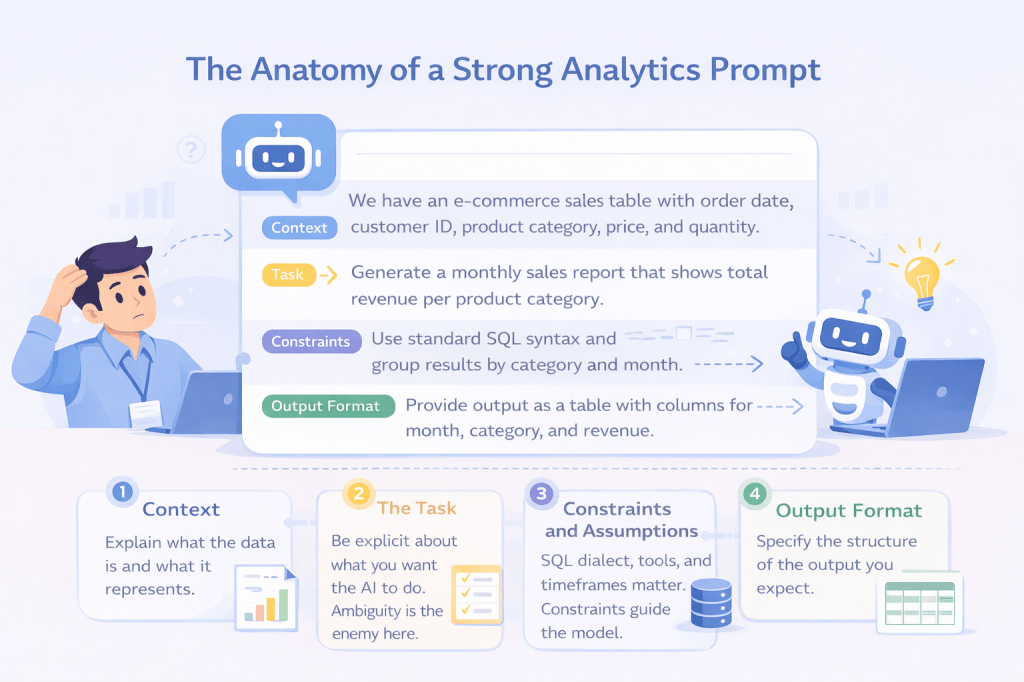
A strong prompt usually includes four parts:
1. Context: Explain what the data is and what it represents.
2. The Task: Be explicit about what you want the AI to do. Ambiguity is the enemy here.
3. Constraints and Assumptions: This is where most people fall short. SQL dialect, tools, timeframes, and limitations all matter. Constraints guide the model and reduce nonsense.
4. Output Format: If you do not specify the format, you will get whatever the model feels like giving. This matters a lot when you plan to reuse the output directly in your workflow.
Common Prompt Engineering Mistakes Analysts Make
Even experienced analysts trip up here.
Some common mistakes:
- Asking multiple unrelated tasks in one prompt
- Forgetting to specify the SQL dialect
- Blindly trusting outputs without validation
- Not correcting the AI when it makes assumptions
- Treating AI as a source of truth instead of a collaborator
AI sounds confident by default. You still need to think critically.
Prompting Tips I Actually Use
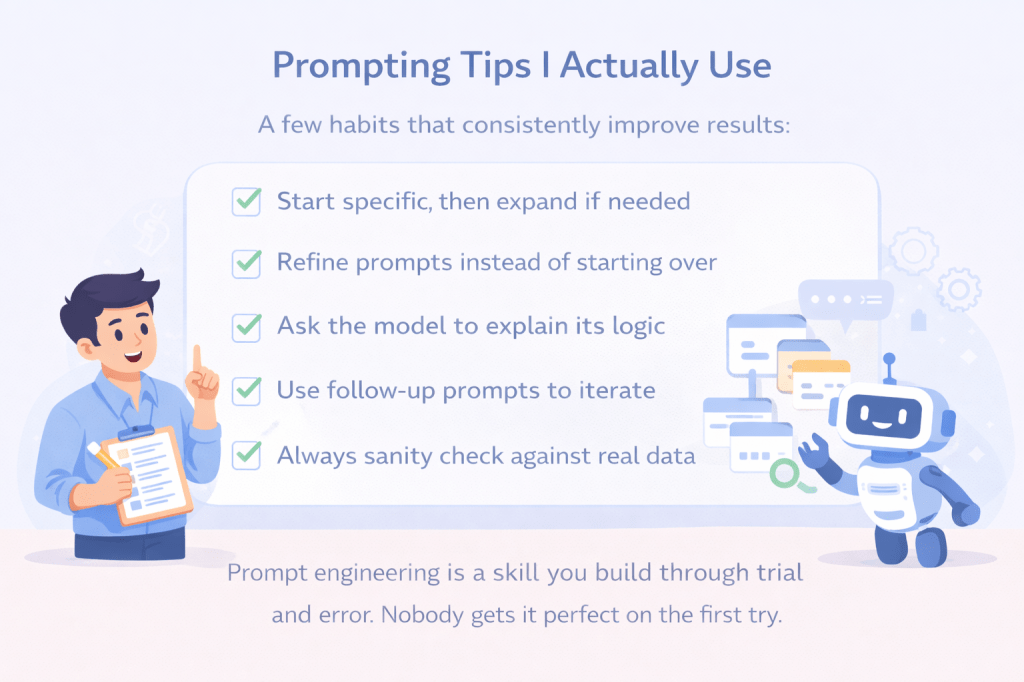
A few habits that consistently improve results:
- Start specific, then expand if needed
- Refine prompts instead of starting over
- Ask the model to explain its logic
- Use follow-up prompts to iterate
- Always sanity check against real data
Prompt engineering is a skill you build through trial and error. Nobody gets it perfect on the first try.
Final Thoughts
Prompt engineering is not a replacement for analytical thinking. It is a multiplier.
When used well, AI becomes a powerful assistant that speeds up your workflow, challenges your assumptions, and helps you communicate insights more clearly. When used poorly, it becomes noise.
As data analysts, our job is not just to get answers. It is to ask better questions. Prompt engineering is simply an extension of that skill.
Byte by byte, question by question.


Leave a Reply