Do you think all data fits neatly into spreadsheets? Well, think again. Your tweets, selfies, and search history don’t follow the rule – and that’s where structured and unstructured data come into play.
Knowing the difference between the two helps you understand how it’s stored, processed, and used to make decisions and gather insights. It also enables you to choose the right tools and approach in data analytics or AI.
📚 Neat, Tidy, Powerful: The Magic of Structured Data
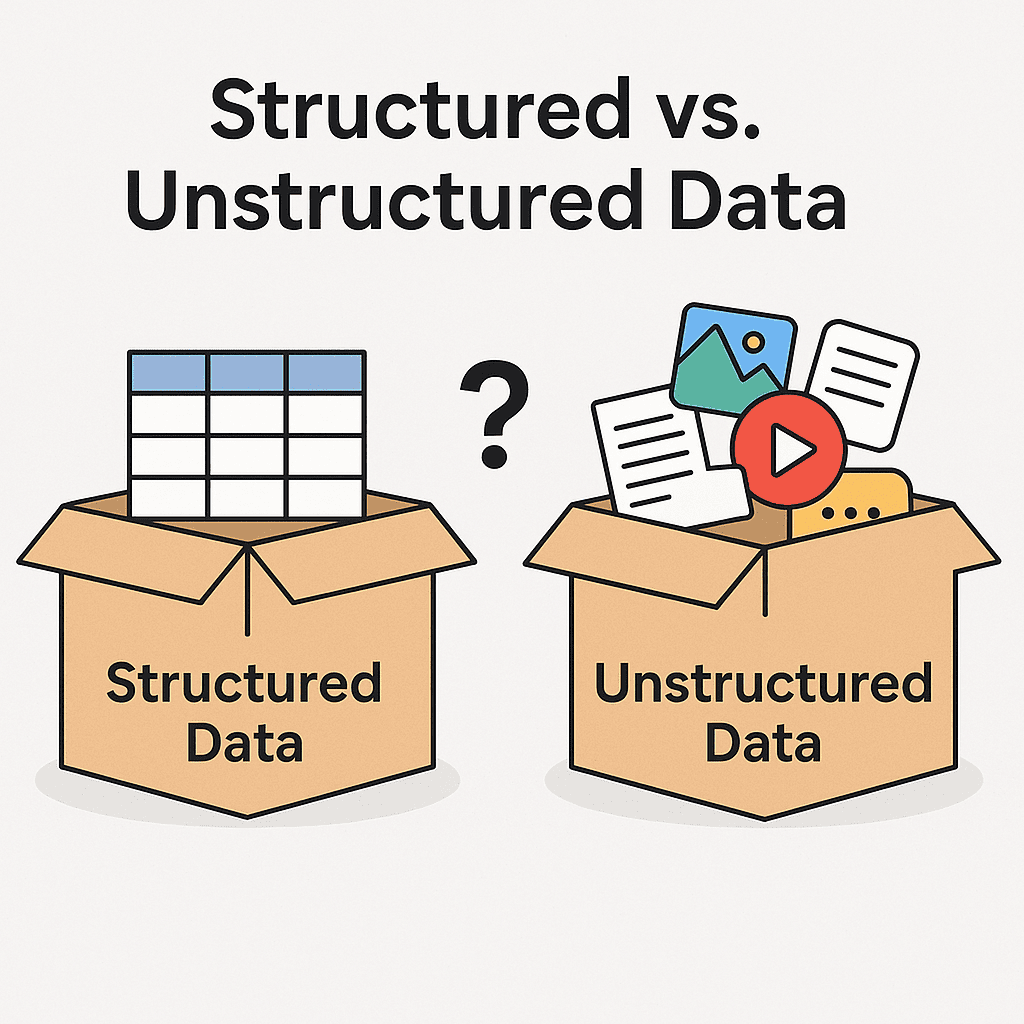
Structured data is what most analysts love: clean, consistent, and query-ready. It is the most straightforward kind of data to work with. It lives in rows and columns, like in a spreadsheet or database – this kind of data enables easy sorting, filtering and analysing of data.
🛠️ Tools: Excel, Google Sheets, PostgreSQL, Power BI, Tableau
📊 Examples: Employee directories, customer orders, time logs, product catalogues, revenue reports

🌀 From Emails to Emojis: Unstructured Data Explained
Unstructured data doesn’t follow a fixed format. It is messy, yet valuable. From tweets to meeting notes, it makes up more than 80% of all data today. But because it lacks structure, it needs more work and smarter tools like AI or NLP processing to extract value.
🛠️ Tools: OpenAI, Hugging Face (NLP), speech-to-text, Apache Hadoop, TensorFlow
📊 Examples: Emails, chat logs, videos, product photos, forum threads, Instagram captions

Unstructured data holds depth, but structured data often drives fast wins. As Pareto’s Principle says, 20% of the data can unlock 80% of the answers.
The AI Implications of Data Types
- AI Model Training: Structured data is used for training traditional machine learning models like decision trees and regression, while unstructured data requires advanced techniques like natural language processing (NLP) and computer vision to extract meaningful features.
- Data Processing Complexity: Unstructured data demands complex preprocessing steps like tokenisation, image segmentation, or audio feature extraction, which can be computationally intensive. Conversely, structured data requires less processing because it is already organised into rows and columns.
- Challenges and Opportunities in AI: The rise of transformer models and deep learning has unlocked the potential of unstructured data, making it critical for innovation in AI-driven fields like healthcare diagnostics, autonomous vehicles, and personalised marketing.

Structured data brings clarity. Unstructured data brings context — once it’s processed. Together, they offer an overview of what’s happening and why. From spreadsheets to social posts, knowing how to work with both leads to smarter, effective decisions.


Leave a Reply