Every time a shiny new technology shows up, the same question pops up: “Is this going to take my job?” Cue the dramatic music. AI is the latest in the lineup, and yes — it’s moving fast.
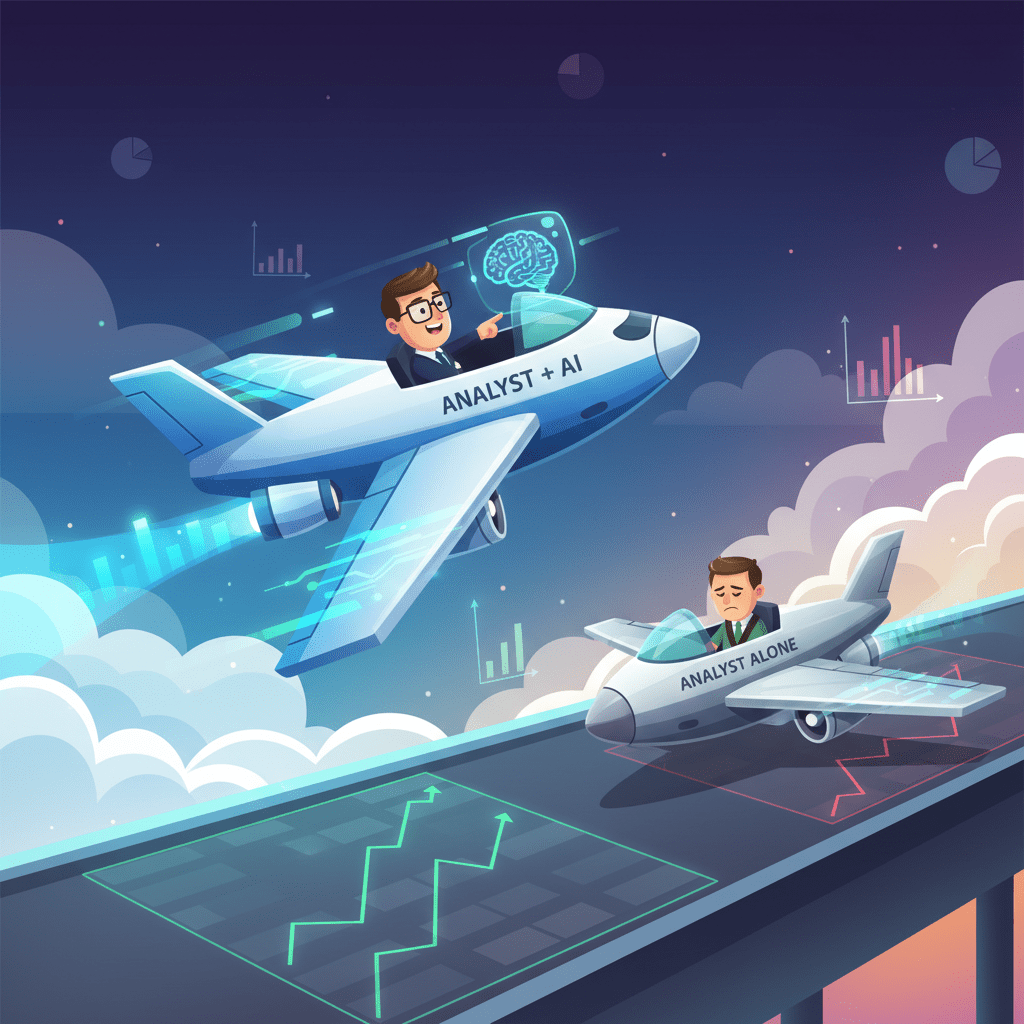
From chatbots to predictive analytics, it’s revolutionising industries everywhere. But here’s the twist: AI isn’t your rival. It’s your ride-or-die sidekick. Your co-pilot. The real divide will be between those analysts who strap in and take off with AI and those still stuck at the gates.

The Myth of AI as a Job Killer
Here’s the thing: AI’s a great autopilot. It works well with automated, repetitive tasks —cleaning messy datasets, flagging anomalies, and generating reports without breaking a sweat. But this is just the mechanical side of analysis. The real magic happens when an analyst interprets the data, connects it to business goals, and turns insights into action.
AI can crunch numbers, but it can’t decide which metric matters most, prioritise trade-offs, or craft a strategy that actually moves the needle. Analysts aren’t being replaced; they’re being empowered to focus on the work that truly drives impact.
If you’ve read my post on AI’s Jagged Frontier, you know that AI’s capabilities are impressive but uneven. It excels at tasks that are structured, repetitive, or data-heavy — like cleaning datasets, spotting anomalies, or generating quick reports. But the frontier is jagged: AI struggles with nuance, context, and judgment. That’s exactly why analysts remain indispensable. Machines can automate routine work, but only humans can interpret insights, prioritise trade-offs, and decide which strategic direction will create real impact. AI isn’t here to replace analysts; it’s here to complement them, filling in the gaps while leaving the high-level decision-making in human hands.
From Data Crunchers to Insight Leaders

Think back five years: analysts spent hours wrangling spreadsheets, reconciling data, and building dashboards. Today, AI takes over that grunt work. That frees analysts to do what machines can’t: ask sharper questions, identify patterns others miss, and guide executives toward better decisions. AI handles the autopilot tasks, while analysts steer the plane. The role isn’t shrinking — it’s evolving into something far more strategic and efficient.
Across industries — from marketing campaigns to financial risk analysis to healthcare data — AI handles the heavy lifting while analysts steer strategy and make the calls that drive real impact.
The Superpowers of an AI-Enabled Analyst
AI doesn’t take the wheel — it handles the grunt work, freeing you to focus on the insights and decisions that actually drive business impact.
With AI riding shotgun, analysts suddenly gain superpowers:
- Speed: Turn data into insights in minutes instead of days.
- Scale: Analyse millions of data points without breaking a sweat.
- Prediction: Stop reporting history and start forecasting the future.
- Storytelling: Transform raw numbers into narratives that drive impact.
AI isn’t replacing analysts — it’s amplifying their impact. By taking care of the repetitive tasks, AI lets analysts focus on high-value decisions, turning them into insight leaders who can navigate complex business challenges with confidence.
The New Analyst Mindset
To thrive in this era, analysts need more than technical chops. Curiosity, critical thinking, and storytelling are just as important as knowing how to run a model. Analysts must also know when to trust AI and when to challenge it.
The best analysts don’t just interpret data — they translate it into action, bridging insights and strategy to shape outcomes that truly matter.
Ready for Takeoff?
AI isn’t your competition — it’s your co-pilot. Analysts who embrace it will take the controls, chart new courses, and soar to new heights. Those who resist? They’ll be left on the tarmac. The question isn’t whether AI will reshape analytics — it already has. The real question is: are you ready to take off?
 Byte by Byte
Leave a comment